The Repair Bench Answer: Scaling "Can You Teach Me Mining?"
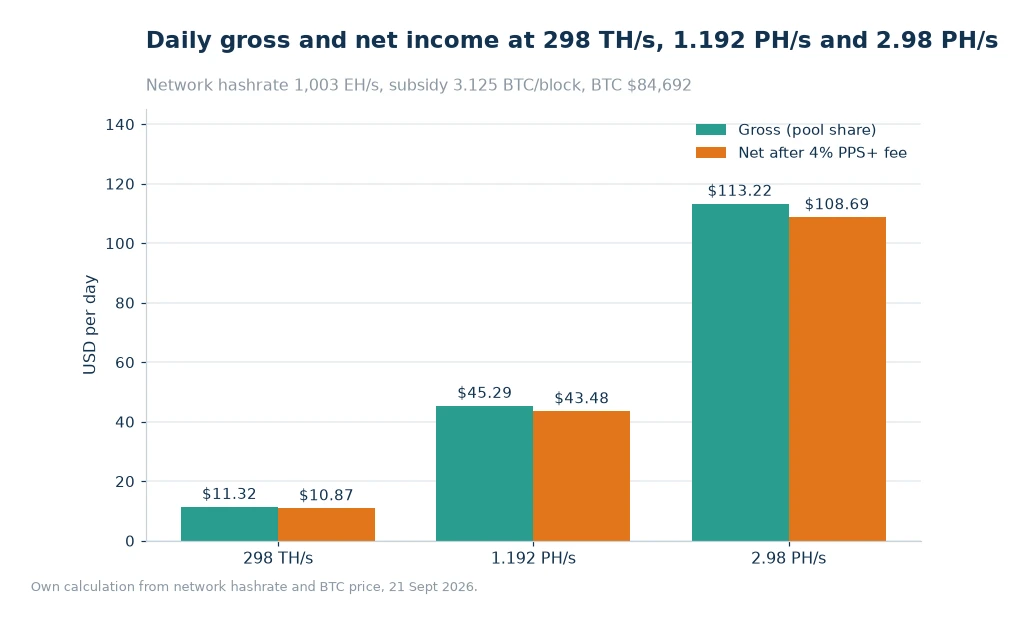
A 298 TH/s machine credits 0.00013368 BTC a day, or $11.32 at $84,692 and $10.87 after the listed 4% on the block-reward component. Owners of machines that come through a repair bench ask about that number constantly, and answering the same question twenty times a month is a scheduling problem as much as a teaching one. A repeatable format fixes both.
Key takeaways
- At 298 TH/s the day is worth 0.00013368 BTC, or $10.87 net after the listed 4%.
- Most first questions are about power, noise and cost, not about pools.
- One scheduled session replaces a month of one-to-one explanations.
- Apply for Ambassador only after the format exists and has run at least twice.
Why the question lands at the bench
A machine arrives for a fan replacement and leaves with a conversation. The owner has usually bought second-hand, plugged it in, watched a pool dashboard for a week, and formed three questions: is this normal, what is it costing me, and what should I buy next. None of those is answerable by a repair ticket, and all of them repeat across customers with almost identical wording.
That repetition is an opportunity rather than a nuisance. Twenty customers asking the same thing are twenty people who would attend a single session, and their questions are a ready-made curriculum. The bench already supplies the credibility; the missing piece is a room, a time and a structure that does not depend on the owner's memory. Once that structure exists, the same hour also answers the people who never come to the counter.
A one-page intake before the session
Ask four things when someone books a place: the machine's model and measured hashrate, the power price on their bill, whether the machine lives in a house or a shed, and what they hoped to spend. The answers sort the room into beginners with realistic expectations and people who have been sold a number that will not survive contact with a power bill.
The intake also protects the session. Someone whose machine cannot run profitably at their tariff needs a different conversation from someone choosing between two efficient units, and mixing the two in one hour wastes both. Offer the intake as a form, keep it short, and use the replies to decide whether the next session is an introduction or a troubleshooting hour. A shared link to the ViaBTC App gives beginners a dashboard to look at before they arrive.
One session instead of twenty conversations
A ninety-minute format works: twenty minutes on where the coins come from, twenty on cost and power, twenty on what breaks, and thirty for questions with a machine running on the bench. The running machine is the anchor. Point at the fans, the meter, the temperature reading, and then at the dashboard, in that order.
Keep the group small enough that questions dominate. Twelve to twenty people is a room; forty is a lecture. If demand exceeds that, run the same session monthly rather than enlarging it, because the value is in the specific answers and those disappear as the group grows. Record the questions that recur and fold them into the next handout, so the material improves even when the attendance stays flat.
Using a program as the structure
The ViaBTC Ambassador Program gives that format a frame: material, a channel for the introductions, and a reason to keep the sessions on a calendar. It does not replace the teaching, and it does not make the numbers kinder. Read the page, then Apply for Ambassador once the sessions have actually happened, because the application asks what you do rather than what you intend.
Before applying, assemble the evidence: dates held, attendance, the handout, and one recording or set of slides. A shop that has run two sessions has more to show than a larger business that has run none. The program is a multiplier on an existing routine, not a substitute for one.
Answers that stay honest
Three questions need a fixed answer. "How much will I make?" gets the arithmetic at today's difficulty with the inputs named, never a monthly promise. "Is this machine good?" gets the daily net at the customer's own tariff, not a verdict about the hardware. "Should I buy more?" gets the cost side: power headroom, noise, a repair budget, and the fact that difficulty moves against a fixed hashrate over time.
The temptation at a bench is to recommend the machine you can service most easily. Resist it out loud. Customers notice when the recommendation changes with the stock on the shelf, and a session that feels like a sales channel stops being attended. If a referral link is shared, say what it is in the same breath and put the sentence on the handout.
| Question | Answer to give | Figure to show |
|---|---|---|
| What will this machine earn? | The current rate at today's difficulty, with the inputs named | $10.87 a day net at 298 TH/s |
| Can I run it at home? | Depends on the tariff, the room and the noise | Power cost against $10.87 |
| Is a second machine worth it? | Only if the first one clears its costs with room to spare | Two units: $21.74 a day net |
| What breaks first? | Fans, then power supplies, then boards | Repair budget versus monthly net |
Worked example
Take the bench machine and follow it through the numbers a customer will ask about.
- Daily network issuance: 144 blocks at 3.125 BTC, which is 450 BTC.
- Per terahash that is 450 ÷ 1,003,000,000 = 0.00000044865 BTC.
- 298 TH/s × 0.00000044865 = 0.00013368 BTC a day.
- At $84,692: 0.00013368 × 84,692 = $11.32.
- After the listed 4%: 11.32 × 0.96 = $10.87.
- Four units, 1,192 TH/s: 4 × 10.87 = $43.48 net a day.
- Ten units, 2.98 PH/s: 10 × 10.87 = $108.69 net a day, or $3,260.70 over 30 days.
- If the customer's power bill for one unit is $6 a day, the margin is $4.87 — enough to matter, thin enough that a repair in the first month changes the story.
Frequently asked questions
Do I need to be a pool representative to run a session?
No. A session is teaching, and the program is a structure around it. Apply when the format exists and has run, and keep the content independent of any single recommendation.
How do I handle a customer whose power is too expensive?
Show the arithmetic rather than an opinion: the daily net at 298 TH/s is $10.87, so a power bill above that leaves nothing. The number ends the conversation more politely than a refusal.
Should the session be free?
Usually yes, at least at the start. A free session fills a room and produces the attendance record and questions that make later material better, while a paid one has to justify itself before it has a track record.
Book the second session before the first ends
Pick the date while people are still in the room, write it on the handout, and ask for one question from each attendee before they leave. Those questions become the agenda, and the agenda becomes the material that a program application can point at. The Miner Profitability Ranking is useful preparation, since it shows how different classes of hardware sit against current conditions without requiring a forecast.
Keep the bench work and the teaching work separate in the calendar. A session squeezed between repairs runs long and answers badly. One evening a month, with the machine on the bench and the handout printed, is enough to turn a recurring interruption into something the shop is known for.
Sources: ViaBTC ambassador and miner ranking pages for program scope and hardware context[1]. Read 21 Sept 2026: hashrate 1,003 EH/s, difficulty 132.76 T, 144 blocks a day of 3.125 BTC, BTC $84,692. Published 24 Oct 2026; the power example is illustrative.