How to Vet a Vietnamese Plywood Factory Before Your First Container
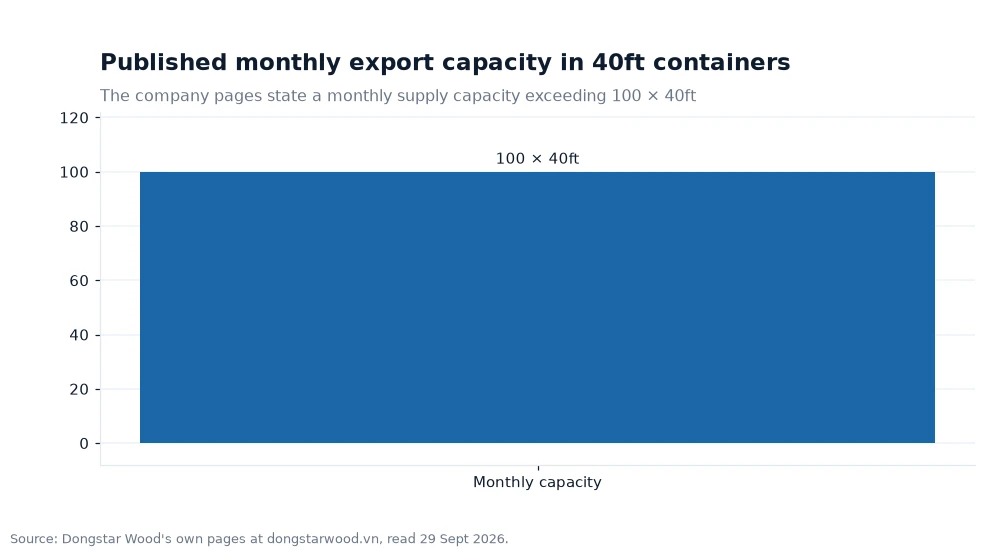
First orders usually fail on paperwork before they fail on panel quality. A mill that publishes 48,000 m² of production space, 16+ automated lines and a monthly supply capacity above 100 × 40ft runs a different operation from a trader with a rented loading bay, and the difference surfaces in documents you can request this week. Below is the order in which those documents are worth checking.
Key takeaways
- Start with footprint — 48,000 m² of production area and more than 3,000 m² of warehousing separate a factory from a trading office.
- Request the six certificate names (ISO, CE, SGS, FSC, EUDR, BSCI) as dated files, not as logos on a homepage.
- Translate capacity into your own rhythm: above 100 × 40ft per month is the published supply figure for one mill.
- Fix size, thickness and glue class in writing before the proforma invoice leaves your desk.
Why the first container is a paperwork decision
The costly errors on a debut order are rarely dramatic. A face grade agreed by telephone, a glue class inferred from a catalogue photograph, a thickness quoted as 18 mm and delivered as 17.4 — each one turns into a claim or a retrospective discount. Writing the specification down before anything is pressed is the least expensive insurance an importer can buy.
That is also why vetting works better as a document hunt than as a conversation. Every claim worth believing is published somewhere or can be sent as a file, and both are checkable before money moves. Dongstar Wood, a manufacturer based in northern Vietnam, is a convenient benchmark because its figures sit on its own pages: a candidate can be measured against that published baseline instead of against a sales pitch, which is a far steadier comparison.
Footprint, lines and the warehouse behind them
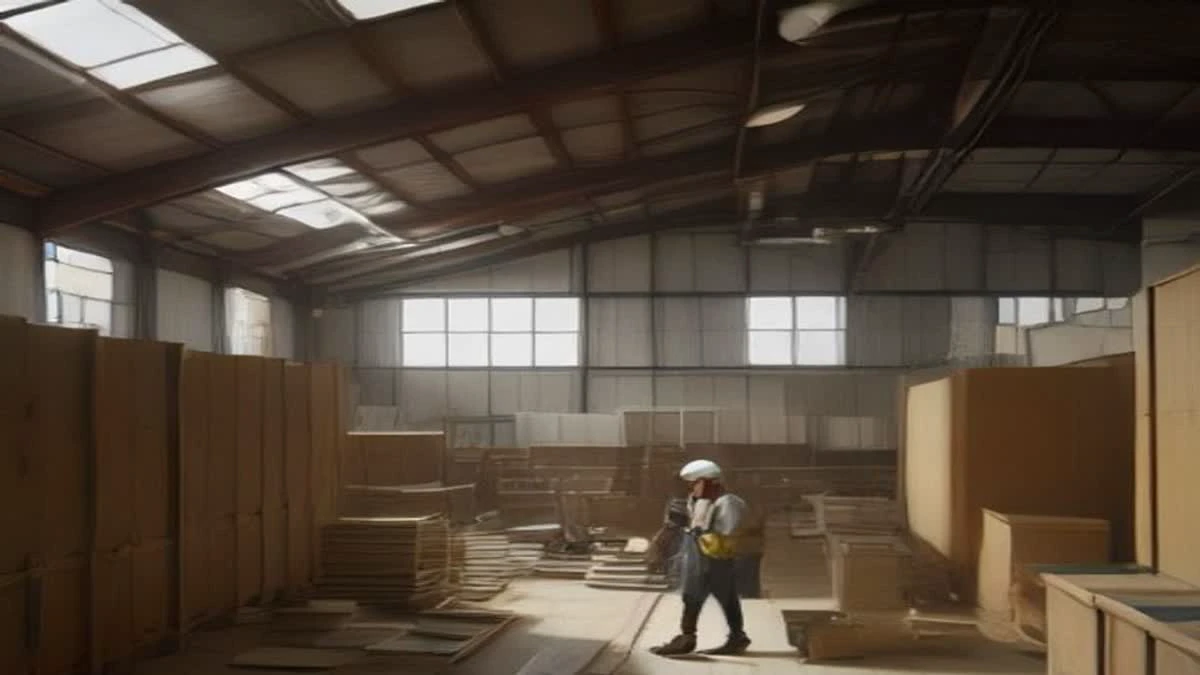
Production area is the first filter. A factory of 48,000 m² with 16+ automated production lines and a warehouse above 3,000 m² has room to dry, press, calibrate and store panels under one roof — the sequence that decides whether thickness tolerance survives a wet month. A trader can quote the same panel but cannot offer the same control.
Ask how the lines are split as well. A plant running six product lines, from furniture and commercial panels to film-faced, LVL, acacia and bodhi boards, schedules your order against whatever is already on the press. The mix tells you where your specification will sit in the queue.
| Item | Published value | Answer that confirms it |
|---|---|---|
| Factory area | 48,000 m² | A layout plan, or a walk through the drying and pressing halls |
| Warehouse | More than 3,000 m² | Photographs of wrapped, labelled and stacked packs |
| Production lines | 16+ automated lines | Which line presses film-faced panels and which runs furniture boards |
| Monthly supply | Exceeding 100 × 40ft | Loading records for the destination market you sell into |
| Certifications | ISO, CE, SGS, FSC, EUDR, BSCI | Scanned certificates with dates and scope, not screenshots |
Certification, EUDR paperwork and what you can request
European buyers now raise deforestation documentation at the quotation stage rather than after the contract. The practical split is between schemes describing the forest side — FSC, and the EUDR readiness the manufacturer advertises — and those describing the panel itself: CE documentation for construction and interior use, CARB P2 and E1/E0 glue classes for emission performance.
Six names appear on the certificate list: ISO, CE, SGS, FSC, EUDR and BSCI. Ask for each as a file with a date and a scope, then check that the scope covers the plant which will press your order. A logo demonstrates marketing effort; a certificate with a reference number demonstrates a process.
Sampling a batch instead of a brochure
A panel cut for a quotation tells you about sales technique. A panel taken from a batch already running tells you about the line, so ask which batch it came from and what the mill measured on it. Directory pages under a heading like Plywood Supplier seldom carry that detail; the question does the work instead.
When the sample lands, verify three things yourself: thickness at four corners with a caliper, edge sealing, and whether the face grade matches the code you ordered. If your specification named a film weight of 165 g/㎡ or 130 g/㎡, that is measurable too.
Worked example: how far a monthly programme stretches
Panel area is what connects an order to a production plan. Take the 1220 × 2440 mm format: 1.22 m by 2.44 m, so 2.98 m² a sheet. The 1250 × 2500 mm format is 1.25 m by 2.5 m, so 3.125 m², and the largest published custom sheet, 1830 × 3830 mm, is 1.83 m by 3.83 m, so 7.01 m².
Example only: a distributor ordering 800 sheets of 1250 × 2500 mm takes 800 × 3.125 = 2,500 m² of panel. Set against published capacity exceeding 100 × 40ft per month, that order is a small share of one mill's programme, which is why a trial lot does not have to fill a container. Run the same arithmetic on the building — 48,000 m² ÷ 16 lines = 3,000 m² per line — and you can see how much floor space stands behind each line.
Loading, packing and the pre-shipment report
The final check happens on the loading dock. Ask for export-standard protective wrapping, steel strapping and wooden pallets, plus the labelling convention your own warehouse reads. Film-faced packs are heavy and unforgiving, and a pallet that fails two months into a European winter is an expensive lesson in packing.
Before the container is sealed, a pre-shipment report should name what was measured. Panel thickness consistency and core construction integrity are the two items batch inspection normally covers. Both are routine, both are easy to produce when testing happens in-house, and both give you something to point at if the shipment disagrees with the sample.
Frequently asked questions
How do I tell a factory from a trading company?
Ask for the production area, the number of lines and the monthly supply capacity in 40ft containers. A factory answers with 48,000 m², 16+ lines and a figure above 100 × 40ft per month; a trader tends to answer with a price and a shipping date and nothing behind either.
Which certificate should a European importer request first?
Start with the one tied to your market rule: CE documentation for construction panels, and FSC plus the EUDR due-diligence papers where timber origin is audited. ISO, SGS and BSCI fill in the management and social side of the same pack.
Is a single trial lot worth arranging?
Usually yes. A trial lot costs a few weeks and tests the parts of the process that scale badly — packing, labelling, panel flatness and how quickly the mill answers a complaint. Those are exactly the problems a distributor cannot repair once a monthly programme has started.
Where the checks leave you
If three of the answers above match your requirement, move to samples rather than more emails. Buyers comparing specifications side by side normally begin with the commercial panel ranges, since face veneer and glue class carry most of the cost, and then read the company profile page for the founding year, the factory area and the certificate set.
Every figure in this article was taken from the maker's own pages, as read on 29 Sept 2026 and used throughout this comparison and used throughout this comparison as the basis for this comparison[1].